Blog
-
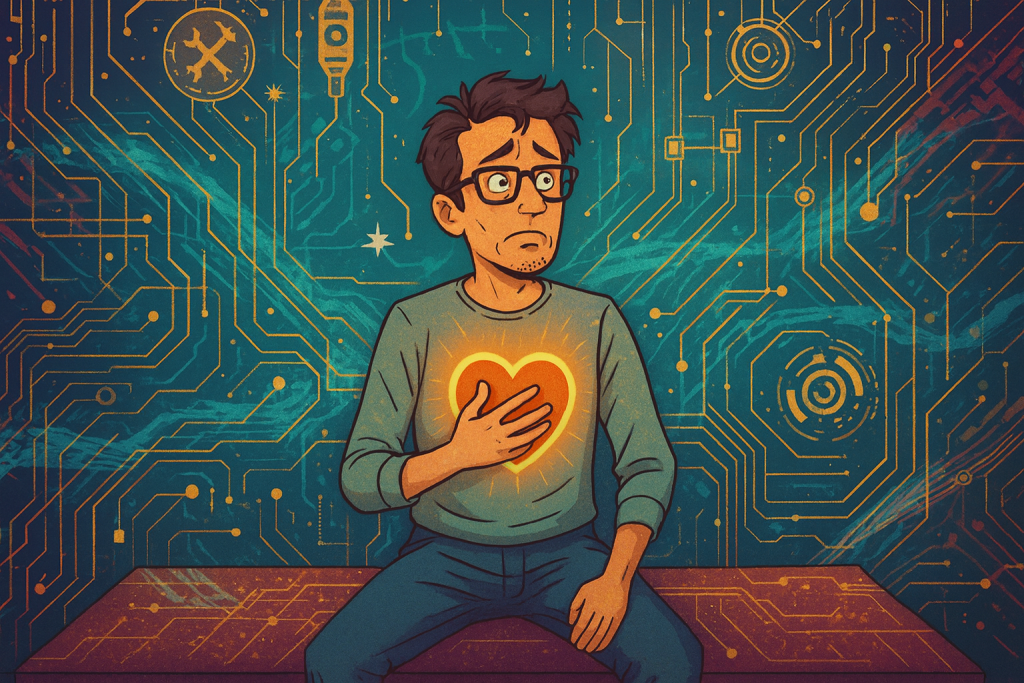
Why AI Can Never Replace Us: The Truth About Being Human
“AI accidentally made me believe in the concept of a human soul by showing me what art looks like without it.” ~Unknown
What is intelligence?
I’ve asked this question all my life—as a teacher, a filmmaker, a researcher, and now, as someone losing my vision to macular degeneration.
I ask it when I watch students find their voice.
I ask it when I listen to a close friend of mine, a world-renowned cosmologist, whose knowledge seems limitless but whose humility runs even deeper. He can discuss black holes one minute and quote the Tao Te Ching the next. He doesn’t …
“AI accidentally made me believe in the concept of a human soul by showing me what art looks like without it.” ~Unknown
What is intelligence?
I’ve asked this question all my life—as a teacher, a filmmaker, a researcher, and now, as someone losing my vision to macular degeneration.
I ask it when I watch students find their voice.
I ask it when I listen to a close friend of mine, a world-renowned cosmologist, whose knowledge seems limitless but whose humility runs even deeper. He can discuss black holes one minute and quote the Tao Te Ching the next. He doesn’t just know facts—he knows how to listen. He knows how to explain something complicated without making you feel small. That, to me, is real intelligence.
And yet… I’ve started to notice something strange.
Artificial Intelligence is beginning to resemble people like him. It can write fluent sentences. It can summarize books I haven’t read. Sometimes, it surprises me. And I find myself wondering: is this also intelligence?
What AI Gets Right—and What It Will Never Feel
Let me say this clearly: I’m grateful for AI. This very essay was shaped with its help. I have advanced macular degeneration. Proofreading my own writing is difficult—sometimes impossible. Tools like this are not a luxury for me. They are a gift. A lifeline. Without them, I wouldn’t be able to keep writing. For that, I’m thankful.
But there is a kind of intelligence that AI will never know.
It won’t feel the panic of forgetting your lines onstage, or the rush of remembering them mid-breath. It doesn’t lie awake at night wondering whether your work matters. It doesn’t weep when your mother no longer remembers your name. It doesn’t get nervous before a job interview. It hasn’t failed, or recovered, or loved.
It can help express a feeling, but it cannot have one.
A Tool, not a Mind
We call it “artificial intelligence,” but it’s more like artificial fluency. It’s fast. It’s competent. It can impress you. But it doesn’t know in the way we know. It hasn’t spent years practicing an instrument in the dark or teaching a student who doesn’t believe in themselves—until one day, they do. It doesn’t grow from experience.
It doesn’t grieve. It doesn’t heal. It doesn’t change.
So when people say, “AI is going to replace us,” I always wonder—which part of us? The part that fills out forms and writes reports or does other rutinary tasks? Maybe. But the part that authentically and honestly tells a story no one else can tell? Never.
Teaching Students to Show Up
In every class I’ve taught, I’ve said some version of this:
“Don’t stop at the research. Don’t stop at what AI gives you. Learn to show up in your work.”
Some students hide behind information. It’s safer. But I tell them: you are the meaning. You are the insight. You are the risk.
I once had a student who wrote a technically flawless paper. But it had no voice. When I asked her what it meant to her, she hesitated. Then she told me about her father, who had lived through the war the paper was about. Her entire relationship to the topic shifted in that moment. That was the real intelligence. Not the citations. Not the syntax. The courage to speak from the heart.
When Sight Fades, Something Else Comes into View
Losing your vision is not just about reading less. It’s about seeing differently. It’s about slowing down. Listening more. Learning to trust what you can’t verify with your eyes.
It has also deepened my appreciation for tools like AI. I rely on them every day. But I also notice their limits. They help with form, but not with essence. They clean the window, but they can’t show you what’s outside. That still requires you.
Intelligence Is Not the Same as Wisdom
My brilliant cosmologist friend once told me, “The more I learn, the more I realize how little I understand.”
AI doesn’t say things like that.
It doesn’t know humility. Or mystery. Or awe.
Intelligence, in the deepest sense, is not about control or answers. It’s about how we carry ourselves in uncertainty. It’s about grace under pressure. Presence in pain. Humor in despair. Kindness without reward. None of that shows up in a prompt.
The Final Lesson: Tools Don’t Replace Soul
If there’s one thing I’ve learned—through teaching, through vision loss, through using AI—it’s this:
A tool can help you build something. But it can’t tell you why it matters.
So yes, use the tools. Use AI. Let it support you. I do.
But never forget: you are more than the tool. You are the story behind the sentence. The silence between the notes. The reason the work matters at all.
That’s not artificial. That’s real.
And it’s irreplaceable.
About Tony Collins
Tony Collins is a documentary filmmaker, educator, and writer whose work explores creativity, caregiving, and personal growth. He is the author of: Windows to the Sea—a moving collection of essays on love, loss, and presence. Creative Scholarship—a guide for educators and artists rethinking how creative work is valued. Tony writes to reflect on what matters—and to help others feel less alone.
Get in the conversation! Click here to leave a comment on the site.
-
Brilliant, Not Broken: A Powerful Reframe for Neurodivergence
“It is not our differences that divide us. It is our inability to recognize, accept, and celebrate those differences.” ~Audre Lorde
For most of my life, I asked myself a quiet question:
What’s wrong with me?
I didn’t say it out loud. I didn’t have to. It was stitched into how I moved through the world — hyperaware, self-correcting, and always just a little out of step. I knew how to “pass” in the right settings, but never without effort. Underneath it all, I was exhausted by the daily performance of normal.
Looking back, it’s clear where it started.
I …
“It is not our differences that divide us. It is our inability to recognize, accept, and celebrate those differences.” ~Audre Lorde
For most of my life, I asked myself a quiet question:
What’s wrong with me?
I didn’t say it out loud. I didn’t have to. It was stitched into how I moved through the world — hyperaware, self-correcting, and always just a little out of step. I knew how to “pass” in the right settings, but never without effort. Underneath it all, I was exhausted by the daily performance of normal.
Looking back, it’s clear where it started.
I grew up in a home marked by emotional chaos and unpredictability. Like many kids with developmental trauma, I became hypervigilant before I even had words for it. I learned to track mood shifts, tones of voice, the silences between the words. While other kids were absorbing math lessons, I was reading the room.
In elementary school, I wasn’t the loud kid or the front-row overachiever. I was the quiet one in the middle row—not bold enough to be in front where people might see me, and not defiant enough to risk the back, where the “bad kids” got called out, punished, or ignored. I learned early that safety meant staying in the middle: visible enough to avoid trouble, invisible enough not to stand out.
I didn’t know what the lesson was. But I knew who the teacher favored and who she didn’t. Who had a rough night at home. Who was trying too hard. Who had checked out. And who was silently hurting the way I was.
I was always paying attention—even if they said I was unfocused—just not in the way the teacher wanted me to.
I also daydreamed. Constantly. I lived in fantasy worlds that I made up in my head, complete with characters, backstories, and dialogue. I wasn’t trying to avoid reality—I was trying to survive it. And those imagined worlds were often kinder than the one I was stuck in.
So when people say things like, “That child is so distractible,” I want to pause them.
Sometimes, what you’re seeing isn’t a disorder. Sometimes, it’s a child adapting to a world that feels unsafe.
What We Call Disordered Might Just Be a Different Kind of Wisdom
As I got older, I started to realize how many of the things we pathologize—especially in women, neurodivergent folks, and trauma survivors—are actually adaptive or even gifted traits. But because they don’t fit the dominant mold of what “healthy” looks like, we call them broken.
Let me say this clearly: Different doesn’t mean disordered. And even when support is needed, that doesn’t mean the person is lacking.
Take ADHD. It’s often reduced to disorganization or forgetfulness, but for many people, it reflects fast-paced, pattern-jumping brains that crave stimulation and thrive in high-innovation spaces. That same brain might struggle in school but light up in entrepreneurship, the arts, crisis work, or tech.
Take anxiety. Yes, it can be overwhelming. But beneath it is usually a sensitive nervous system attuned to energy, risk, nuance. In trauma survivors, it often reflects the ability to read between the lines—to sense what’s not being said, to prepare for every possible outcome. They keep themselves and others safe by seeing the risks before the bad thing happens.
Take autism, especially in girls and women. What gets labeled as rigidity or social awkwardness might actually be deep authenticity, truth-telling, and sensory brilliance in a world full of noise and social masking.
Even depression can be a form of wisdom—a body demanding rest, a soul refusing to keep performing, a nervous system finally saying “enough.”
What Neurodivergence Really Means
Neurodivergence isn’t one thing. It’s a big umbrella. It includes conditions like:
- ADHD
- Autism
- Learning differences (like dyslexia or dyscalculia)
- Sensory processing differences
- Mood disorders (sometimes)
- PTSD and C-PTSD (especially when they cause long-term brain changes)
For some, it’s hardwired. For others, it’s trauma-shaped. And for many of us, it’s both.
In my own family, neurodivergence runs deep.
My mother lived with bipolar disorder and schizophrenia. My oldest son has ADD and anxiety. My youngest is autistic, has an intellectual disability, and also lives with ADHD. I’ve carried complex PTSD, anxiety, depression—and honestly, probably undiagnosed ADD too.
We are not broken. We are not less.
We are a line of deeply sensitive, differently wired humans trying to survive in a world that doesn’t always recognize our kind of brilliance.
I know what it is to be the outcast.
I watched my mom become one—judged and misunderstood by her own family, dismissed by society because her bipolar and schizophrenia made people uncomfortable. I’ve watched my youngest son become one too. He’s autistic, has an intellectual disability, and ADHD. And I know—deeply know—that if I hadn’t chosen to value his wiring, the world might have crushed him. For a little while, it did.
But this kid plays the drums like nobody’s business.
He is fiercely protective, wildly loyal, and more emotionally intuitive than anyone I’ve ever met.
And every once in a while, he’ll say something so specific, so strange, so piercingly true, I swear he’s reading my mind — or someone else’s.We don’t talk about this kind of intelligence enough. The kind that doesn’t show up on standardized tests or IQ charts, but lives in the bones. In the music. In the knowing.
Neurodivergence simply means your brain functions in a way that diverges from the norm. That’s not bad. That’s essential—because the “norm” was never built with all of us in mind.
The Bigger Picture
We live in a culture that rewards sameness: attention that stays linear, emotions that stay tidy, learning that happens on schedule.
But real life is messier than that. And real people are more complex.
Some of the most powerful thinkers, healers, leaders, and artists I know live with labels that would’ve sidelined them if they hadn’t learned to translate their differences into power.
Different doesn’t take away from the conversation. It adds to it.
And the next time you wonder if something is “wrong” with you, pause.
What if that part of you isn’t broken?
What if it’s just misunderstood?
What if it’s trying to show you something the world forgot how to hear?
About Allison Briggs
Allison Jeanette Briggs is a therapist, writer, and speaker specializing in helping women heal from codependency, childhood trauma, and emotional neglect. She blends psychological insight with spiritual depth to guide clients and readers toward self-trust, boundaries, and authentic connection. Allison is the author of the upcoming memoir On Being Real: Healing the Codependent Heart of a Woman and shares reflections on healing, resilience, and inner freedom at on-being-real.com.
Get in the conversation! Click here to leave a comment on the site.
-
Dr. Stephan Schmidheiny: The Swiss Entrepreneur Who Coined ‘Eco-Efficiency’ Before It Was Mainstream
Rather than viewing environmental protection as a cost center, Schmidheiny developed the concept of eco-efficiency, which demonstrated how enterprises could combine environmental protection with economic growth.
The post Dr. Stephan Schmidheiny: The Swiss Entrepreneur Who Coined ‘Eco-Efficiency’ Before It Was Mainstream appeared first on Green Prophet.
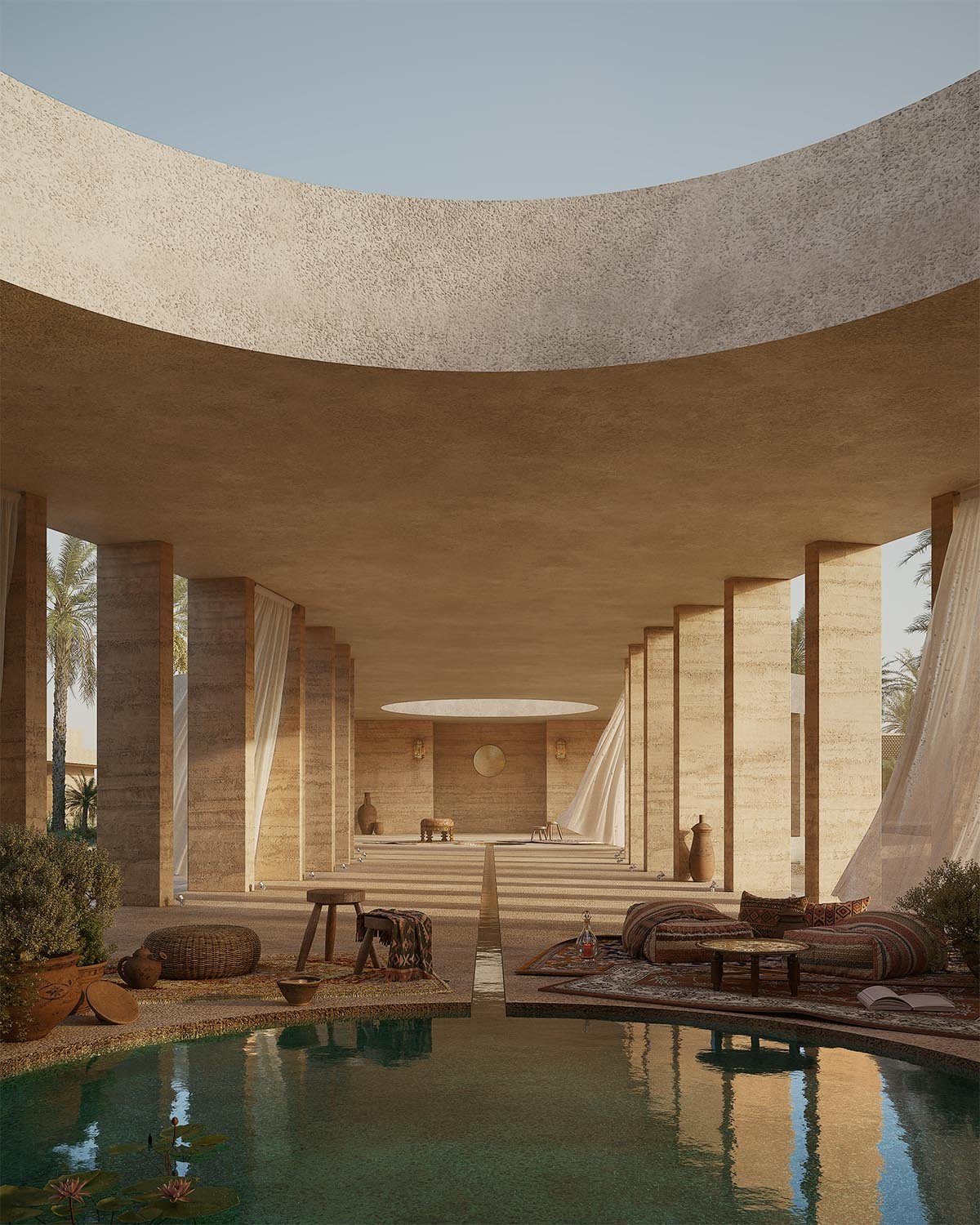
In the far reaches of Abu Dhabi’s Western Region, where the Rub’ al Khali desert stretches endlessly into Saudi Arabia, a new architectural vision is rising. Mexican architect Inca Hernández has unveiled Liwa Farm Village, a 7,000-square-meter project that reimagines what it means to live, work, and grow in harmony with one of the world’s harshest landscapes.
The project is sited near the Liwa Oasis, long revered as a lifeline in the desert. For centuries, this oasis shaped the livelihoods, fortifications, and traditions of the Emirate. The new design draws directly from this legacy—acknowledging the deep cultural roots of aflaj irrigation systems, vernacular desert architecture, windcatchers, and rammed-earth construction, while weaving them into a future-facing community space.
Hernández’s studio emphasizes construction methods that are both ecological and ancestral. Rammed-earth walls, strengthened with desert sand and pigmented concrete, anchor the village against the elements, offering natural thermal insulation in a place where heat defines daily life. Raised platforms protect buildings from seasonal shifts, while clay latticework channels breezes and shades interiors—an echo of the ingenious wind towers of old Arabia.
The result is architecture that breathes with the desert rather than imposing upon it. But why does it take a Mexican to re-imagine the past of the Arab world? Foreign influence on design, culture and architecture is far too common in Middle East oil countries eager to be bold and speaking the common language of the built environment of the west. The Arabian horse arrives on cue.
A Community Shaped by Nature and Cultur
e
The layout unfolds like a living museum of desert traditions:
-
Date palm groves and agricultural plots integrate with housing and community spaces (all about date palms and sustainability).
-
A veterinary center and horse paddocks safeguard animal welfare while serving as an educational hub.
-
The Majlis, topped with palm-frond roofing, offers a space for gathering, reflection, and storytelling
-
A restaurant and spa bring visitors into contact with the flavors, scents, and healing practices of the region
Each structure, from modest earthen houses for farmers to grand arches inspired by desert dunes, is designed to blur boundaries between built form and natural process.
Hernández describes the project as “reviving vernacular techniques to preserve the land’s bounty while renewing traditions that give life to the present—and future.” It is a philosophy visible in every detail, from clay lattice roofs that scatter desert light to ponds that reflect the memory of the oasis.
By rooting Liwa Farm Village in the Al Gharbia region’s heritage, the design does more than preserve memory, a memory that the UAE seems so quick to forget, taken a foreign architect to re-imagine it. Hernández creates a place for exchange between past and present, locals and visitors, humans and land. This is not just a farm or a cultural center. It is a vision of coexistence—a desert village that tells the story of resilience across generations.
Project facts
Project facts: Liwa Farm Village
Lead Architect: Inca Hernandez.
Location: Bateen Liwa, Abu Dhabi, UAE.
Team: Evelin García, Luis Enrique Vargas, Jesús Navarro, Alfonso Castelló.
Construction area: 7,000m2
Land area: 30,000m2
Year: 2025
The post Inca Hernández Brings Liwa Farm Village to Life in Abu Dhabi, Rooted in Desert Heritage appeared first on Green Prophet.
-