
Blog

  • New study points to possible long-term damage on the keto diet

    New study points to possible long-term damage on the keto diet

    The good news: when the mice stopped the ketogenic diet, their metabolism began to recover. But the overall message remains cautionary. “I would urge anyone to talk to a health care provider if they’re thinking about going on a ketogenic diet,” Gallop advised.

    The post New study points to possible long-term damage on the keto diet appeared first on Green Prophet.


    man hipster beard deli europe

    A keto diet is based on meat and fat. Scientists say the diet improves spatial memory and visual memory, lowers indices of brain inflammation, causes less neuronal death and slows down the rate of cellular aging.

    A new study published in Science Advances by researchers at the University of Utah Health raises serious questions about the long-term safety of the ketogenic diet — the popular high-fat, low-carbohydrate eating plan that promises fast weight loss and sharper focus.

    The research, conducted on mice, shows that while keto can prevent weight gain, it may also cause fatty liver disease and impair blood sugar regulation, with some harmful changes appearing in just days.

    “We’ve seen short-term studies and those just looking at weight, but not really any studies looking at what happens over the longer term or with other facets of metabolic health,” said Molly Gallop, PhD, now an assistant professor of anatomy and physiology at Earlham College, who led the study as a postdoctoral fellow in nutrition and integrative physiology at U of U Health.

    From Epilepsy Treatment to Diet Trend

    Originally developed as a treatment for epilepsy nearly a century ago, the ketogenic diet forces the body into a metabolic state called ketosis, where fat — rather than carbohydrates — becomes the primary energy source. While short-term results can include reduced seizures, rapid fat loss, and improved insulin sensitivity, the new findings suggest that long-term effects may be more troubling.

    “One thing that’s very clear is that if you have a really high-fat diet, the lipids have to go somewhere, and they usually end up in the blood and the liver,” explained Amandine Chaix, PhD, senior author of the study and assistant professor of nutrition and integrative physiology at U of U Health.

    Researchers fed male and female mice one of four diets for nine months — the human equivalent of several years. Those on the classic ketogenic diet, where nearly all calories come from fat, gained less weight than mice on a Western diet. But despite staying slimmer, they developed severe metabolic complications, including fatty liver disease.

    The liver damage appeared especially pronounced in male mice. Females seemed somewhat protected, and scientists plan to investigate why. The study also uncovered a paradox. After two to three months, keto-fed mice had low levels of blood sugar and insulin — seemingly positive indicators. Yet when given carbohydrates, their blood sugar spiked dangerously and stayed high.

    “The problem is that when you then give these mice a little bit of carbs, their carb response is completely skewed,” said Chaix. “Their blood glucose goes really high for really long, and that’s quite dangerous.”

    Further investigation showed that insulin-producing cells in the pancreas were under stress and not functioning properly. The high-fat environment appeared to damage how these cells handled proteins, disturbing their ability to secrete insulin.

    A Reversible but Serious Warning

    The good news: when the mice stopped the ketogenic diet, their metabolism began to recover. But the overall message remains cautionary. “I would urge anyone to talk to a health care provider if they’re thinking about going on a ketogenic diet,” Gallop advised.

    If these results hold true in humans, long-term ketogenic diets may carry serious health risks, including fatty liver disease and impaired blood sugar regulation — even if the scale shows success. More research is needed to sound the alarm, but consider talking to your doctor before you start a new diet is the take home message.

    Read on for more ket news you can use

    The post New study points to possible long-term damage on the keto diet appeared first on Green Prophet.

  • Eating History With The Bronze Age Bread You Can Bake in Your Kitchen Today

    Eating History With The Bronze Age Bread You Can Bake in Your Kitchen Today

    The discovery in Turkey offers a rare physical example of bread from ~3300 BCE, giving insights into ancient diet, agriculture and ritual (the loaf was buried beneath a home’s threshold, suggesting a symbolic role). The revival in modern Turkey not only connects bread to cultural heritage, but promotes ancient grains (less‐common, drought-tolerant) and sustainable agriculture.

    The post Eating History With The Bronze Age Bread You Can Bake in Your Kitchen Today appeared first on Green Prophet.

    Firedome launches retardants at fires

    Imagine a world where forest wild fires are stopped before the fire trucks even roll. That’s what Israeli startup FireDome just showed in its first real-world demo of an autonomous wildfire resilience system — a machine-vision launcher that spots small fires and catapults eco-friendly flame retardant capsules to snuff them out in seconds.

    The system uses AI-powered detection to track smoke, heat, and movement, making split-second decisions on where to aim and release biodegradable capsules filled with water or retardant. The goal: to contain wildfires before they spread. It could save factories and land managers millions on insurance premiums. And save people in California the grief from wildfires. Personal home versions are in the works.

    “This is the turning point,” said Gadi Benjamini, CEO and Co-Founder of FireDome. “Wildfires are getting bigger, costlier, and harder to insure against. Our technology acts in seconds to protect lives and landscapes before first responders arrive.”

    FireDome’s platform defines what it calls Wildfire Resilience-as-a-Service (RaaS) — a new model that merges detection, decision-making, and suppression into one holistic defense system for communities, utilities, vineyards, and resorts living with wildfire risk.

    “FireDome exemplifies the kind of breakthrough that can change how we live with wildfire risk,” added Dr. Lori Moore-Merrell, former U.S. Fire Administrator and FireDome advisor.

    Co-founded in 2024 by Gadi Benjamini, CEO, and Dr. Adi Naor Pomerantz, CTO, FireDome is a wildfire resilience-as-a-service company delivering automated, precision detection and suppression systems designed to protect lives, property, and critical infrastructure.

    Co-founded in 2024 by Gadi Benjamini, CEO, and Dr. Adi Naor Pomerantz, CTO, FireDome is a wildfire resilience-as-a-service company delivering automated, precision detection and suppression systems designed to protect lives, property, and critical infrastructure.

    With climate change turning wildfires into a year-round menace, FireDome’s automated response could help insurers, landowners, and municipalities rethink what resilience looks like — using technology not to fight nature, but to act before disaster strikes.

    ::Firedome

    The post FireDome’s AI eyes the flames and catapults eco-flame retardants to save forests, homes and factories appeared first on Green Prophet.

  • What has more protein – spirulina or a steak?

    What has more protein – spirulina or a steak?

    While both spirulina and beef provide “complete” protein (i.e., containing all essential amino acids), the absorption and usability of that protein by the human body may differ. Animal-sourced proteins are often considered more easily digestible and more strongly tied to muscle repair and growth, though the exact difference can depend on numerous factors including cooking method, other dietary components and individual digestive efficiency.

    The post What has more protein – spirulina or a steak? appeared first on Green Prophet.

    Firedome launches retardants at fires

    Imagine a world where forest wild fires are stopped before the fire trucks even roll. That’s what Israeli startup FireDome just showed in its first real-world demo of an autonomous wildfire resilience system — a machine-vision launcher that spots small fires and catapults eco-friendly flame retardant capsules to snuff them out in seconds.

    The system uses AI-powered detection to track smoke, heat, and movement, making split-second decisions on where to aim and release biodegradable capsules filled with water or retardant. The goal: to contain wildfires before they spread. It could save factories and land managers millions on insurance premiums. And save people in California the grief from wildfires. Personal home versions are in the works.

    “This is the turning point,” said Gadi Benjamini, CEO and Co-Founder of FireDome. “Wildfires are getting bigger, costlier, and harder to insure against. Our technology acts in seconds to protect lives and landscapes before first responders arrive.”

    FireDome’s platform defines what it calls Wildfire Resilience-as-a-Service (RaaS) — a new model that merges detection, decision-making, and suppression into one holistic defense system for communities, utilities, vineyards, and resorts living with wildfire risk.

    “FireDome exemplifies the kind of breakthrough that can change how we live with wildfire risk,” added Dr. Lori Moore-Merrell, former U.S. Fire Administrator and FireDome advisor.

    Co-founded in 2024 by Gadi Benjamini, CEO, and Dr. Adi Naor Pomerantz, CTO, FireDome is a wildfire resilience-as-a-service company delivering automated, precision detection and suppression systems designed to protect lives, property, and critical infrastructure.

    Co-founded in 2024 by Gadi Benjamini, CEO, and Dr. Adi Naor Pomerantz, CTO, FireDome is a wildfire resilience-as-a-service company delivering automated, precision detection and suppression systems designed to protect lives, property, and critical infrastructure.

    With climate change turning wildfires into a year-round menace, FireDome’s automated response could help insurers, landowners, and municipalities rethink what resilience looks like — using technology not to fight nature, but to act before disaster strikes.

    ::Firedome

    The post FireDome’s AI eyes the flames and catapults eco-flame retardants to save forests, homes and factories appeared first on Green Prophet.

  • The first bread was baked in Jordan’s Black Desert

    The first bread was baked in Jordan’s Black Desert

    The Natufian hearths from Jordan’s Black Desert invite a reframing of food history. Bread and beer were not simply by-products of agriculture; the desire for these transformed foods may have helped drive cultivation itself. They also remind us that ingenious, place-based foodways—wild grains, tubers, local milling, communal baking—were born in arid lands and basalt fields. As climate stresses grow, that lesson in resilience and resourcefulness from the deep past feels timely.

    The post The first bread was baked in Jordan’s Black Desert appeared first on Green Prophet.

    Firedome launches retardants at fires

    Imagine a world where forest wild fires are stopped before the fire trucks even roll. That’s what Israeli startup FireDome just showed in its first real-world demo of an autonomous wildfire resilience system — a machine-vision launcher that spots small fires and catapults eco-friendly flame retardant capsules to snuff them out in seconds.

    The system uses AI-powered detection to track smoke, heat, and movement, making split-second decisions on where to aim and release biodegradable capsules filled with water or retardant. The goal: to contain wildfires before they spread. It could save factories and land managers millions on insurance premiums. And save people in California the grief from wildfires. Personal home versions are in the works.

    “This is the turning point,” said Gadi Benjamini, CEO and Co-Founder of FireDome. “Wildfires are getting bigger, costlier, and harder to insure against. Our technology acts in seconds to protect lives and landscapes before first responders arrive.”

    FireDome’s platform defines what it calls Wildfire Resilience-as-a-Service (RaaS) — a new model that merges detection, decision-making, and suppression into one holistic defense system for communities, utilities, vineyards, and resorts living with wildfire risk.

    “FireDome exemplifies the kind of breakthrough that can change how we live with wildfire risk,” added Dr. Lori Moore-Merrell, former U.S. Fire Administrator and FireDome advisor.

    Co-founded in 2024 by Gadi Benjamini, CEO, and Dr. Adi Naor Pomerantz, CTO, FireDome is a wildfire resilience-as-a-service company delivering automated, precision detection and suppression systems designed to protect lives, property, and critical infrastructure.

    Co-founded in 2024 by Gadi Benjamini, CEO, and Dr. Adi Naor Pomerantz, CTO, FireDome is a wildfire resilience-as-a-service company delivering automated, precision detection and suppression systems designed to protect lives, property, and critical infrastructure.

    With climate change turning wildfires into a year-round menace, FireDome’s automated response could help insurers, landowners, and municipalities rethink what resilience looks like — using technology not to fight nature, but to act before disaster strikes.

    ::Firedome

    The post FireDome’s AI eyes the flames and catapults eco-flame retardants to save forests, homes and factories appeared first on Green Prophet.
  • Polluters like L’Oreal may need to pay for polluting EU waterways

    Polluters like L’Oreal may need to pay for polluting EU waterways

    A new EU directive is forcing pharmaceutical and cosmetics companies to pay for removing drug residues from wastewater after a major study found 175 pharmaceuticals polluting Europe’s rivers. The industry is fighting back, but scientists warn that without urgent action, these invisible chemicals will continue to poison aquatic life and seep into our drinking water.

    The post Polluters like L’Oreal may need to pay for polluting EU waterways appeared first on Green Prophet.

    Firedome launches retardants at fires

    Imagine a world where forest wild fires are stopped before the fire trucks even roll. That’s what Israeli startup FireDome just showed in its first real-world demo of an autonomous wildfire resilience system — a machine-vision launcher that spots small fires and catapults eco-friendly flame retardant capsules to snuff them out in seconds.

    The system uses AI-powered detection to track smoke, heat, and movement, making split-second decisions on where to aim and release biodegradable capsules filled with water or retardant. The goal: to contain wildfires before they spread. It could save factories and land managers millions on insurance premiums. And save people in California the grief from wildfires. Personal home versions are in the works.

    “This is the turning point,” said Gadi Benjamini, CEO and Co-Founder of FireDome. “Wildfires are getting bigger, costlier, and harder to insure against. Our technology acts in seconds to protect lives and landscapes before first responders arrive.”

    FireDome’s platform defines what it calls Wildfire Resilience-as-a-Service (RaaS) — a new model that merges detection, decision-making, and suppression into one holistic defense system for communities, utilities, vineyards, and resorts living with wildfire risk.

    “FireDome exemplifies the kind of breakthrough that can change how we live with wildfire risk,” added Dr. Lori Moore-Merrell, former U.S. Fire Administrator and FireDome advisor.

    Co-founded in 2024 by Gadi Benjamini, CEO, and Dr. Adi Naor Pomerantz, CTO, FireDome is a wildfire resilience-as-a-service company delivering automated, precision detection and suppression systems designed to protect lives, property, and critical infrastructure.

    Co-founded in 2024 by Gadi Benjamini, CEO, and Dr. Adi Naor Pomerantz, CTO, FireDome is a wildfire resilience-as-a-service company delivering automated, precision detection and suppression systems designed to protect lives, property, and critical infrastructure.

    With climate change turning wildfires into a year-round menace, FireDome’s automated response could help insurers, landowners, and municipalities rethink what resilience looks like — using technology not to fight nature, but to act before disaster strikes.

    ::Firedome

    The post FireDome’s AI eyes the flames and catapults eco-flame retardants to save forests, homes and factories appeared first on Green Prophet.
  • FireDome’s AI eyes the flames and catapults eco-flame retardants to save forests, homes and factories

    FireDome’s AI eyes the flames and catapults eco-flame retardants to save forests, homes and factories

    FireDome’s platform defines what it calls Wildfire Resilience-as-a-Service (RaaS) — a new model that merges detection, decision-making, and suppression into one holistic defense system for communities, utilities, vineyards, and resorts living with wildfire risk.

    The post FireDome’s AI eyes the flames and catapults eco-flame retardants to save forests, homes and factories appeared first on Green Prophet.

    Firedome launches retardants at fires

    Imagine a world where forest wild fires are stopped before the fire trucks even roll. That’s what Israeli startup FireDome just showed in its first real-world demo of an autonomous wildfire resilience system — a machine-vision launcher that spots small fires and catapults eco-friendly flame retardant capsules to snuff them out in seconds.

    The system uses AI-powered detection to track smoke, heat, and movement, making split-second decisions on where to aim and release biodegradable capsules filled with water or retardant. The goal: to contain wildfires before they spread. It could save factories and land managers millions on insurance premiums. And save people in California the grief from wildfires. Personal home versions are in the works.

    “This is the turning point,” said Gadi Benjamini, CEO and Co-Founder of FireDome. “Wildfires are getting bigger, costlier, and harder to insure against. Our technology acts in seconds to protect lives and landscapes before first responders arrive.”

    FireDome’s platform defines what it calls Wildfire Resilience-as-a-Service (RaaS) — a new model that merges detection, decision-making, and suppression into one holistic defense system for communities, utilities, vineyards, and resorts living with wildfire risk.

    “FireDome exemplifies the kind of breakthrough that can change how we live with wildfire risk,” added Dr. Lori Moore-Merrell, former U.S. Fire Administrator and FireDome advisor.

    Co-founded in 2024 by Gadi Benjamini, CEO, and Dr. Adi Naor Pomerantz, CTO, FireDome is a wildfire resilience-as-a-service company delivering automated, precision detection and suppression systems designed to protect lives, property, and critical infrastructure.

    Co-founded in 2024 by Gadi Benjamini, CEO, and Dr. Adi Naor Pomerantz, CTO, FireDome is a wildfire resilience-as-a-service company delivering automated, precision detection and suppression systems designed to protect lives, property, and critical infrastructure.

    With climate change turning wildfires into a year-round menace, FireDome’s automated response could help insurers, landowners, and municipalities rethink what resilience looks like — using technology not to fight nature, but to act before disaster strikes.

    ::Firedome

    The post FireDome’s AI eyes the flames and catapults eco-flame retardants to save forests, homes and factories appeared first on Green Prophet.

  • When the Body Freezes: On Love and Grief in Midlife

    When the Body Freezes: On Love and Grief in Midlife

    “I was constantly seeking a balance between mourning what’s already been lost, making space for the time and moments we still had left, and making sense of this complicated process that felt like my heart was split between two contrasting realities: hope and heartbreak.” ~Liz Newman

    There is a quiet heaviness that begins to settle into many of us in midlife.

    It doesn’t announce itself with drama. It slips in through unanswered emails from an aging parent, through half-slept nights spent wondering how we will ever afford live-in care, or whether that one fall they had was the beginning …

    “I was constantly seeking a balance between mourning what’s already been lost, making space for the time and moments we still had left, and making sense of this complicated process that felt like my heart was split between two contrasting realities: hope and heartbreak.” ~Liz Newman

    There is a quiet heaviness that begins to settle into many of us in midlife.

    It doesn’t announce itself with drama. It slips in through unanswered emails from an aging parent, through half-slept nights spent wondering how we will ever afford live-in care, or whether that one fall they had was the beginning of the end.

    It’s not grief exactly. It’s the shadow of grief that lingers before the loss, that creeps in through ordinary moments and whispers that everything is slowly, quietly, but undeniably changing.

    My mother has Parkinson’s. She lives alone in the UK while I live abroad—untethered by design, a traveling healer by choice—except now that freedom feels like it comes at a cost I never calculated.

    She has started falling. Backwards. Her voice is nearly gone. I can barely understand her over the phone anymore, and every time she forgets a detail or struggles to find a word, my stomach knots.

    I wonder when the dementia will get worse and instead of only forgetting my birthday, she will also forget about me: her eldest daughter. I wonder how long she can live on her own. I wonder what happens when things really go south.

    And I panic.

    The truth is, I can’t just pack up and move to the UK. Not anymore. Not with Brexit and visa restrictions. These days, my visits are brief, limited to a few weeks or months at a time. Right now, I’m here for the summer, doing what I can while I can.

    Add to that the financial uncertainty of running a healing business and the lack of steady income to support full-time care. The weight of it all settles quietly. Like many of us, I carry it in silence and swallow the worry. I fold it into my body, into the slope of my shoulders. The right one, to be exact.

    Until one morning I wake up, and I can’t move my right arm the way I used to. Turning it inward sends a sharp pain up through my upper arm. At first, I think I must have slept weirdly. But when the pain lingers for days, my hypochondriac side takes over. I start googling symptoms. And frozen shoulder pops up.

    I pause. Then I type in “spiritual meaning of frozen shoulder.”

    And everything clicks.

    In spiritual traditions, the shoulder is where we carry burdens that were never ours. It’s where we hold onto responsibility, overcare, and all the invisible weight of things unsaid.

    When a shoulder freezes, it may be our body’s way of saying, “I can’t carry this anymore.”

    A frozen shoulder can also signify:

    • Suppressed grief or emotion, often near the heart
    • Over-responsibility and carrying others’ pain
    • Fear of moving forward, or feeling stuck
    • A lack of energetic boundaries
    • A subconscious attempt to halt motion when our lives demand change

    All of these mirror how I feel about my mother. The anticipatory grief. The helplessness. The guilt. The stuckness of being in-between countries, in-between decisions, and in-between who I was and who I need to become. Wanting to take care of her and to sign the power of attorney papers and equally not wanting to do any of it because it’s just so damn painful.

    The Midlife Guilt That Has No Language

    There is no manual for this phase of life. For the moment when your mother still lives but is slipping. When you are still someone’s child but also now the one silently parenting the parent. When love no longer feels light but edged with dread and uncertainty.

    And unlike childhood, this stage has no defined rite of passage. We often endure it quietly, bravely, invisibly. We plan around it. We work through it. We cry into our pillows about it.

    We don’t want to be seen as selfish. We don’t want to fail them. We don’t want to map a life of meaning only to feel like we missed the most important chapter back home. And then the body begins to speak.

    Reclaiming the Self While Loving the Mother

    Healing my shoulder may take time. Physically and emotionally. But it has also been an invitation to ask: Where am I over-caring? Where am I still trying to prove my worth through sacrifice? What if I let myself hold love and limits?

    Maybe I don’t need to force myself to stay for an entire summer out of guilt that I otherwise don’t live nearby.

    I don’t yet have all the answers about my mother’s care. But I know this:

    • I don’t need to disappear to honor her: I don’t need to dim my joy in front of her so she doesn’t feel the contrast of what she’s lost.
    • I don’t need to break to be a good daughter: I don’t need to say yes to every request out of fear that one day, she won’t be able to ask, nor do I need to say “I’m fine” when I’m anything but.
    • I don’t need to put my dreams on hold to make up for the years I wasn’t there, or carry the weight of what I couldn’t prevent.

    Maybe the most radical thing we can do, in a world where many of us live oceans away from aging parents, is to stop blending ourselves into the expectations of those who stayed behind. Our parents. Our siblings. The ancestral and societal chorus of “You owe them everything.”

    Because the truth is we can’t always return. Not like generations before. The village is gone, the visa expired, the life we’ve built stretches across time zones and cultures.

    Maybe we need to learn to soften the guilt without hardening our hearts. I wonder if we can learn how to grieve the distance without erasing ourselves. Can we find a new kind of middle path where love is not measured by geography but by presence, honesty, and the quiet ways we still show up?

    What if love is no longer a burden carved from duty but a bond held with tenderness and boundaries?

    If your shoulder aches too, or your chest feels heavy or your body is acting up in any way, pause. Because we were never meant to disappear into devotion and carry too much. We were meant to love with presence. To grieve with grace. And to remain visible, even while honoring those we come from.

    I have come up with a few journaling prompts I will journal through myself. If they are in any way helpful on your own journey, please feel free to do the same:

    Journaling Prompts for the Tender Weight We Carry

    1. Where in my body am I holding what feels too heavy to say aloud? What does this part of me wish I would finally hear or honor?

    2. What roles or responsibilities have I inherited culturally, ancestrally, or emotionally that no longer feel sustainable? Am I willing to release or reimagine them?

    3. When I think of caring for my aging parent, what emotions arise beneath the surface and beyond obligation? What fears, guilt, or grief live there?

    4. What does love look like without self-sacrifice? Can I write a version of devotion that includes my wholeness?

    5. If my body were writing me a letter right now about how I’ve been living, what would it say? What boundaries or changes might it ask me to consider?

    If you do, share in the comments what realizations came up for you.

    About Lais

    Lais is a writer, intuitive healer, and space-clearing expert. Through her Quantum Energy Healing Program, she facilitates deep transformation by clearing ancestral wounds, past-life imprints, and energetic blocks. Download her free digital journal to invite in more alignment into your life here. She also hosts The Alchemy of Light and Shadow Podcast & Happy Home Space Clearing Podcast. Learn more about her work here, or sign up to the Space Clearing Academy Waitlist here.

    Get in the conversation! Click here to leave a comment on the site.

  • Recipe: Mushrooms Cooked in Grapevine Leaves

    Recipe: Mushrooms Cooked in Grapevine Leaves

    Grapevine leaves are usually thought of as wraps or savory little parcels stuffed with rice and/or meat. But as our previous post on fish grilled in grapevine leaves shows, the leaf of the grape is more versatile than that. This recipe is said to have originated in France. I can’t guarantee it did, but  a […]

    The post Recipe: Mushrooms Cooked in Grapevine Leaves appeared first on Green Prophet.

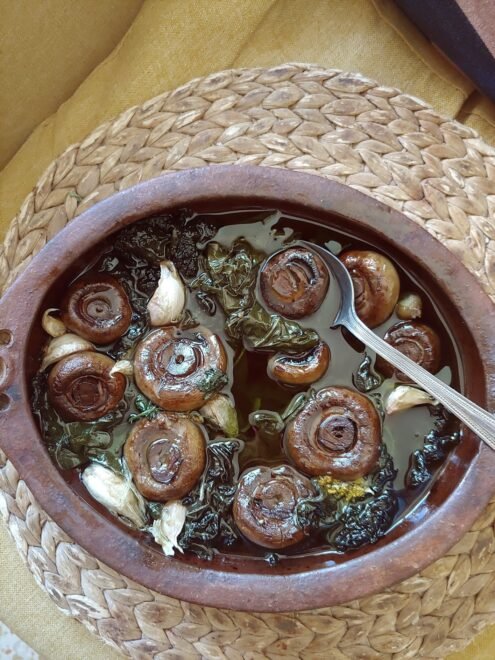
    mushrooms cooked in grapevine leaves

    Grapevine leaves are usually thought of as wraps or savory little parcels stuffed with rice and/or meat. But as our previous post on fish grilled in grapevine leaves shows, the leaf of the grape is more versatile than that.

    This recipe is said to have originated in France. I can’t guarantee it did, but  a dish like this one logically evolves wherever mushrooms and vineyards thrive in the same local. The tangy, woodsy flavor of the grapevine leaves complements the earthy mushrooms. Olive oil and garlic are natural added ingredients. You’ll be wafted to the Mediterranen when you lift the leaf cover and the irresistible aroma rises.

    A jar of grapevine leaves in brine makes cooking quick and easy if you can’t get fresh leaves. Make sure to extract the leaves gently from the jar, because the brine makes them fragile. Although you’re not filling and rolling them, as in Iraqi stuffed grape leaves, you may want the unused leaves to make dolamades some time later.

    You’ll need a shallow baking dish with either a tightly fitting lid or foil to cover the dish well.

    mushrooms covered in grapevine leaves

    Print

    Mushrooms Cooked In Grapevine Leaves

    An easy Mediterranean mushroom dish
    Course Side Dish
    Cuisine Mediterranean
    Keyword mushrooms, grapevine leaves
    Prep Time 15 minutes
    Cook Time 30 minutes
    Servings 4

    Ingredients

    • 4 cups – 300 grams – fresh button mushrooms.
    • Grapevine leaves to cover the bottom of a baking dish in one layer plus added leaves to cover the mushrooms
    • 1/2 cup olive oil
    • 1/2 tsp sea salt
    • 8 whole peeled garlic cloves
    • 1/2 tsp. Ground black pepper

    Instructions

    • Preheat the oven to 325° F – 165° C
    • Rinse the grape leaves and leave to drain in a colander or on a kitchen towel.
    • Rinse the mushrooms and pat them dry.
    • Remove and chop the stems coarsely; set the stems aside.
    • Halve any particularly large mushrooms.
    • Line a baking dish with grape leaves in a single layer.
    • Pour half the olive oil over the leaves.
    • Place the sliced or whole mushrooms over the leaves.
    • Put the chopped stems around the mushrooms.
    • Poke the garlic cloves into any empty spaces around the mushrooms.
    • Sprinkle everything with salt and pepper to taste.
    • Cover the dish with grape leaves.
    • Pour the second half of the olive oil over all.
    • Cover the dish with a tightly fitting lid or foil.
    • Bake for 30 minutes.
    • Spoon some of the cooking juices over the mushrooms and garlic cloves, and serve.

    Notes

    mushrooms covered in grapevine leaves

    The leaves covering the mushrooms will be dark and crunchy. If you cooked this with fresh grapevine leaves, they will be tender enough to eat, and tasty.

    Any remaining cooking juices can be added to a sauce, poured over steamed vegetables or stirred into mashed potatoes.

    Photos by Miriam Kresh

    The post Recipe: Mushrooms Cooked in Grapevine Leaves appeared first on Green Prophet.

  • When Friendship Is One-Sided: Letting Go of Someone Who Was Never Really There

    When Friendship Is One-Sided: Letting Go of Someone Who Was Never Really There

    “Finally, I realized that I was never asking too much. I was just asking the wrong person.” ~Unknown

    Friendship should nourish the soul. And in my life, for the most part, it has. I have a small, longstanding circle of friends steeped in a long-shared history. We’re basically a real-life, thirty-five-year-long John Hughes film.

    However, every now and then, a hornet in disguise has buzzed into my life and stung.

    He was one of them. A bad sting.

    Love Bombing

    Right off the bat, knowing him felt amazing.

    I was still reeling from the aftereffects of living with an abusive

    “Finally, I realized that I was never asking too much. I was just asking the wrong person.” ~Unknown

    Friendship should nourish the soul. And in my life, for the most part, it has. I have a small, longstanding circle of friends steeped in a long-shared history. We’re basically a real-life, thirty-five-year-long John Hughes film.

    However, every now and then, a hornet in disguise has buzzed into my life and stung.

    He was one of them. A bad sting.

    Love Bombing

    Right off the bat, knowing him felt amazing.

    I was still reeling from the aftereffects of living with an abusive man who died a few months after I finally got away. Emotionally raw, my nervous system felt like it was covered in third-degree burns being scrubbed with a Brillo pad.

    But this new friend? He felt safe. Quiet. Peaceful.

    He wanted to see me multiple times a week. He introduced me to his child. We spent time watching TV, going out for drinks and dinner, living in what felt like a comforting routine. His good morning texts became a comfort for my sleepy eyes.

    It felt good. Really good.

    Until it didn’t.

    A Bouquet of Red Flags? For Me?

    Small things began happening that just didn’t sit well.

    He began to speak ill of others in our mutual friend group. If he’s talking about them like this, what is he saying about me? Then I’d dismiss it. No, Jennifer. He’s a good friend.

    Once, when I asked him to repay money he owed me, I received a semi-scathing text accusing me of not being a “real friend,” because “real friends” don’t expect repayment. Am I here to subsidize your income?

    You’d think I walked away entirely at that point. No, not quite.

    When There’s No Communication, There’s No Friendship

    Instead, I drank too much one night and made out with him. (Stop judging me.)

    I felt uncomfortable and needed to talk about it. I asked if I could come over for a quick chat. He declined. He was “too busy gardening.”

    Right. Gardening. Okay.

    The good morning texts stopped. The invitations to hang out vanished.

    Days later, I texted, “Are you upset with me? We usually see each other all the time, and I haven’t heard from you.”

    His reply: “I’m not upset.” No explanation. No elaboration.

    Five weeks passed. Silence. Crickets.

    And it hurt—more than I expected. I had let someone in after a traumatic experience. I was vulnerable, open, willing to trust again. But the friendship only existed on his terms. Everything was fine—until I asked for emotional accountability.

    Inner Work and Uncomfortable Truths

    After doing a lot of inner work, I realized something painful: I have a pattern of projecting qualities onto people that they simply don’t possess. I want people to be kind, emotionally intelligent, and loyal. So, I make them that way in my mind.

    But people are who they are—not who I wish them to be.

    And for my own well-being, that pattern had to end.

    Not everyone is ready to do the work. And that’s fine. I can only be responsible for my healing, my boundaries, my growth.

    In any relationship—be it romantic, familial, professional, or platonic—every individual has a right to be seen, heard, and valued. To be acknowledged as a complete person with thoughts, feelings, and needs.

    Our voices and wants should be respected and celebrated. Without this foundation of trust, emotional safety, and genuine connection, we begin to feel invisible, diminished, or invalidated.

    And sometimes the most loving thing we can do for ourselves is to leave a space that no longer aligns with who we are.

    It’s not about giving up on people too quickly but recognizing when staying becomes a quiet betrayal of our own needs.

    Self-Respect and Goodbye

    So how did I move forward?

    After acknowledging a deeper truth—that I had lived in a place of unworthiness for far too long, repeatedly allowing myself to be manipulated and emotionally abandoned—I decided to no longer chase breadcrumbs and worked hard on setting clear boundaries. And if those aren’t respected, I give myself permission to walk away.

    And I walked away from him. I declined invites where I knew he’d be present and performed a digital detox: the phone number, the photos, the threads—all deleted. Unfollow. Unfollow. Unfollow.

    And none of it happened out of anger or malice, but from a place of peace. A place of self-respect.

    In the end, we teach others how to treat us by what we allow, and leaving is sometimes the most powerful way to be seen and heard—by ourselves most of all.

    I was whole before I met him. And I remained whole after saying goodbye.

    A Final Note

    Not every friend is meant to stay. Not every connection nourishes the soul.

    Some buzz in for a bit, give a quick sting, and buzz right back out.

    The lesson? To stop letting ourselves be stung over and over again.

    About Jennifer Tomlin

    Jennifer is an advertising copywriter with over twenty-five years in the creative services and corporate communications field, A lover of animals, coffee, and music, she resides in the Philadelphia suburbs. Contact Jennifer at jennifertomlinwrites.com.

    Get in the conversation! Click here to leave a comment on the site.

  • Recipe: Fish Grilled in Grapevine Leaves With Chilli Dipping Sauce

    Recipe: Fish Grilled in Grapevine Leaves With Chilli Dipping Sauce

    If you’ve only ever eaten grapevine leaves as dolmades, you’ll be surprised to learn that those tangy grape leaves add luxurious flavor to a variety of other dishes. You’re lucky if you have access to a green, growing grapevine in the spring, when you can pick the fresh leaves and process them at home. It’s […]

    The post Recipe: Fish Grilled in Grapevine Leaves With Chilli Dipping Sauce appeared first on Green Prophet.

    If you’ve only ever eaten grapevine leaves as dolmades, you’ll be surprised to learn that those tangy grape leaves add luxurious flavor to a variety of other dishes.

    You’re lucky if you have access to a green, growing grapevine in the spring, when you can pick the fresh leaves and process them at home. It’s easy enough. Just a matter of blanching them briefly in boiling water, then cold. You’ll have the satisfaction of successful foraging.

    But say you have a yen for stuffed grape leaves and it’s way past the season for picking. You can forage the leaves, already preserved in brine, at your local grocery store. Here’s our Iraqi Stuffed Grape Leaves recipe for starters.

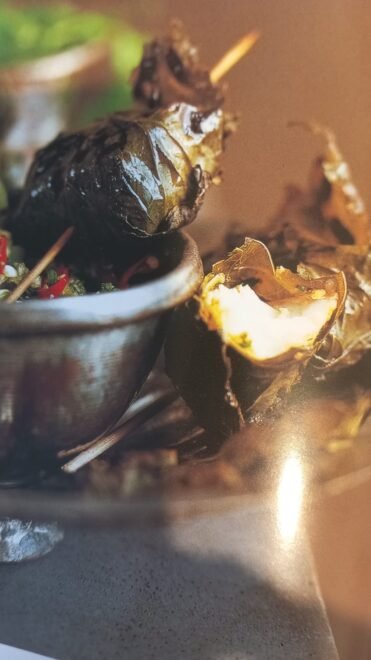
    Keep a jar of grape leaves in the pantry for inspiration. Go vegan, or not. Choose to wrap cheese, or mushrooms, or fish in grapevine leaves. We’re offering you the first in a series of grape vine leaf-inspired recipes to brighten meals any time: grilled fish in vine leaves, then dipped in a spicy-hot, herby sauce. The fish is marinated for an hour in a coriander-based chermoula dressing.

    Print

    Grilled Fish in Grapevine Leaves With Sweet and Sour Chilli Sauce

    Fish wrapped in grapevine leaves and grilled, served with a spicy sauce.
    Course Main Course
    Cuisine Middle Eastern
    Keyword Moroccan, Spicy
    Servings 4

    Ingredients

    For Fish:

    • 30 vine leaves in brine
    • 4-5 firm white fish fillets such as haddock, snapper, grouper

    Chermoula:

    • 1 Small bunch of fresh coriander leaves
    • 2-3 garlic cloves
    • 2 tsp ground cumin
    • 4 Tblsp olive oil
    • Juice of 1 lemon
    • Salt

    Dipping Sauce:

    • 1/4 cup white wine vinegar or lemon juice
    • 1/2 cup superfine sugar or 1/2 cup plus 1 tsp granulated sugar
    • 1-2 Tblsp water
    • Pinch saffron threads
    • 1 onion finely chopped
    • 2 garlic cloves finely chopped
    • 3 scallions finely sliced
    • 1 oz. Fresh grated ginger root
    • 2 hot chillies seeded and finely sliced
    • Small bunch fresh coriander leaves finely chopped
    • Small bunch fresh mint finely chopped

    Instructions

    • Process the chermoula ingredients in a food pr0cessor or blender. Pour into a large bowl.
    • Rinse the vine leaves, then soak in cold water to remove most of the brine.
    • Cut fillets into eight bite sized pieces.
    • Marinate the fish pieces in the chermoula for 1 hour.
    • Heat the vinegar or lemon juice, sugar and water. Stir until sugar dissolves.
    • Boil one minute, then cool.
    • Add the remaining ingredients; blend.
    • Drain the vine leaves and pat dry.
    • Lay a leaf flat on the work surface. Place a piece of marinated fish in the center.
    • Fold the edges of the leaves over the fish. Make a parcel by wrapping with extra leaves.
    • Repeat until all the fish pieces are wrapped in the leaves.
    • Thread the parcels onto kebab skewers. Brush with any leftover marinade.
    • Heat the broiler to the highest setting.
    • Cook the kebabs 2-3 minutes on each side.
    • Serve hot with the chilli dipping sauce.

    Note: the chilli sauce is also wonderful with our chicken-stuffed mulberry leaves, which our editor Karin kitchen-tested and loved.)

    Recipe and photo from Recipes From A Moroccan Kitchen by Ghillie Bașan.


    The post Recipe: Fish Grilled in Grapevine Leaves With Chilli Dipping Sauce appeared first on Green Prophet.