
Heat pumps and why you should get one to save the planet
- Posted on December 4, 2025
Heat pumps don’t create heat — they move it. In winter they pull warmth from the air or ground and bring it indoors, and in summer they reverse the cycle to cool. By shifting heat instead of burning fuel, heat pumps use significantly less energy than conventional HVAC systems.
The post Heat pumps and why you should get one to save the planet appeared first on Green Prophet.
Building back home and dignity can work with local, sustainable materials
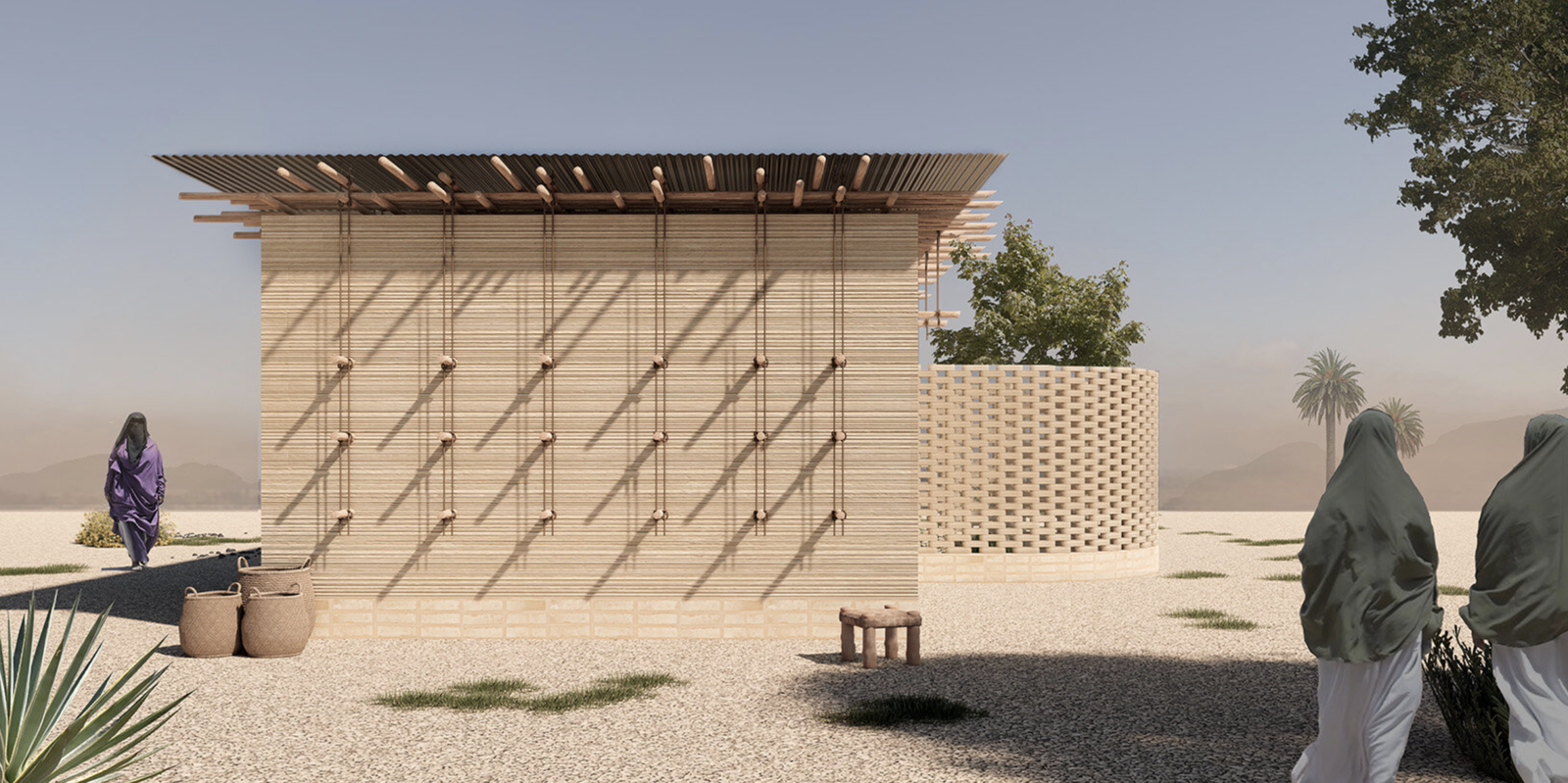
Somalia faces one of the world’s most persistent displacement crises, with millions uprooted by conflict, drought, and climate-driven instability. As emergency camps grow into semi-permanent settlements, the need for long-term, affordable, and culturally grounded housing becomes urgent. A new proposal, Shelters of the Future, offers precisely that: a mud-brick modular framework rooted in Somali building traditions yet designed for resilience, dignity, and community.
Developed by designer Rabie Al Ashi in Saudi Arabia in collaboration with Kengo Kuma & Associates, Shelters of the Future won first prize in an international competition led by Somalia’s Ministry of Public Works, Reconstruction and Housing (MoPWRH), the International Organization for Migration (IOM), and Young Architects Competition (YAC). It stands out for its elegant simplicity: a shelter system that relies on local materials, local skills, and local cultural logic.
With so much goodwill going into designing new refugee shelters from the western world –– see our 2014 article on refugee shelters from IKEA and designers in Jordan, we are still seeing Gazans and Somalis living under tarps.
Read our article: Refugee shelters we hate to love
Still, we celebrate ideas and appreciate this design because it works with vernacular materials and takes into account the local.
At the heart of the design is a flexible 4×4-meter module, a human-scaled unit pairing two enclosed rooms with a semi-open central space and a private garden. This small footprint is deceptively powerful: it gives each household privacy, a safe outdoor space, and the ability to arrange interior life according to Somali social norms. The module becomes a building block—units can be combined into courtyards, linear clusters, or circular compounds that echo traditional Somali settlement patterns. Compare this to the shelters Somalis have built in Yemen, below.
Materiality grounds the system firmly in place. Structures are built from mud bricks, acacia logs, palm leaves, and earth-based plasters—materials that are renewable, inexpensive, and readily available. Mud bricks in particular offer thermal mass, keeping interiors cooler during the day and warmer at night, an essential feature in Somalia’s hot, arid climate.
Construction is intentionally low-tech: shelters can be built by residents themselves, strengthening local craftsmanship and reducing reliance on imported humanitarian products that often fail in desert climates.
A UN photo of Somalis sheltering in Yemen
The design also incorporates passive cooling strategies—cross-ventilation, shaded openings, and breathable walls—to make life more comfortable without the need for electricity. Gender-sensitive layouts support safety and cultural expectations. Small gardens, livestock spaces, and shaded communal zones help rebuild livelihoods and social cohesion.
We’ve spent weeks in Sinai in the simple hushas there made from palm fronds and bamboo. They can be remarkably comfortable even at night when the cold winds blow.
A basic husha in Sinai built by Bedouin
Rather than treating displacement as a temporary emergency, this project is reframed as a human condition requiring stability, community, and dignity. By combining vernacular wisdom with adaptable modular planning, the project offers a model for refugee housing that is scalable, low-carbon, and deeply respectful of local identity.
For Somalia’s displaced families, a mud-brick home may be the most modern solution of all.
::IOM
The post Emergency housing and refugee shelters made from mud appeared first on Green Prophet.
Related Posts
Recommended Story For You :

Bringing Dead Batteries Back To Life Is Simple!

SEPTIFIX to the Rescue! Say Goodbye to Problems and Hello to Savings

Ecomposing of Paper Towels Produce Methane Gas

A Leading Cause Of Global Warming!
A cleaner world where energy is abundant essentially free
and sourced directly out of the inherent power of the space surrounding us.

MIT Discovery can cut power bills by 65%

Easy DIY Power Plan Will Change Our World Forever
Discover the World with Our Passionate Geography Teacher in Memphis!